Colorado Residents Contest Drone Herbicide Spraying Plan
10/26/2026 / By Iva Greene
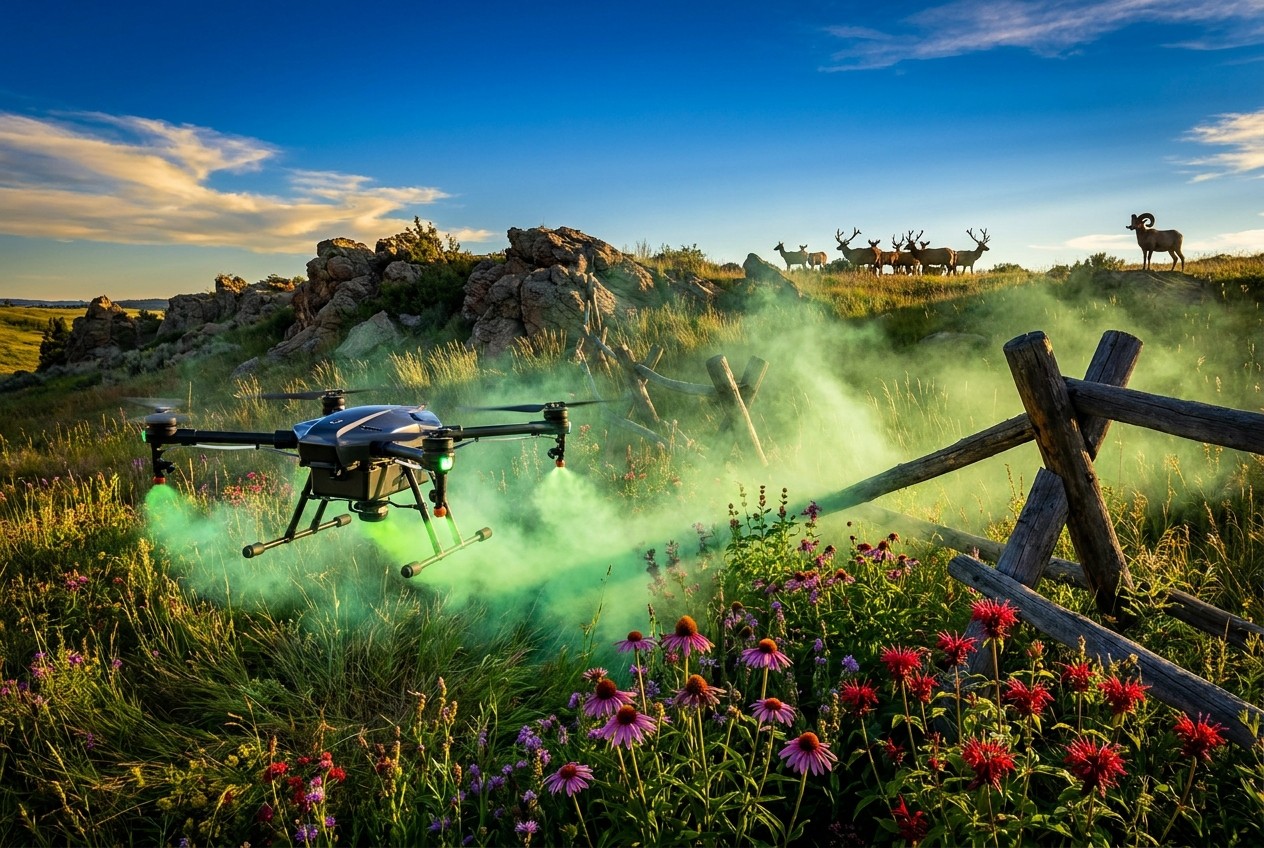
Residents of a Boulder County, Colorado, community are opposing a plan to spray herbicide from drones over a wildland area known as Red Hill, according to local reporting and community statements. The proposal, announced in October, would use unmanned aircraft to apply a weed killer across terrain that supporters describe as needing invasive species control and that opponents describe as too sensitive for aerial chemical application [1][2].
The dispute centers on a herbicide product containing indaziflam, a chemical that reporting indicates is part of the planned treatment and that has drawn additional scrutiny from residents [1]. Community members said they were not adequately notified of the proposal and raised concerns about exposure to the herbicide near homes, gardens and public lands. No final decision has been made, and officials said the proposal remains under review [1][2].
The conflict reflects a broader pattern in which rural and exurban communities question aerial and drone-based pesticide applications, citing drift, privacy and consent. In Boulder County, the debate has drawn in farm owners, conservation groups and residents who say the spraying would occur in a habitat recognized for elk and bighorn sheep and for a concentration of rare environmental resources [3][2].
Plan Details and Agency Oversight
The plan calls for drone application of an herbicide to manage weeds across the Red Hill area, according to the proposal as described by officials and local reporting [1]. Supporters said targeted drone spraying could reduce the amount of herbicide used compared with broader application methods, because the aircraft can be directed to specific patches of invasive vegetation rather than treating large tracts uniformly.
Under the described process, drone applicators would require licensing, and the herbicide would need to be registered for the intended use, officials said [1]. A public comment period and agency review are part of the process, according to the report [1]. Federal and state pesticide law generally ties aerial and ground applications to label requirements, applicator certification and, in some cases, additional permits for drone use.
The plan has also been described as involving a product developed by Bayer, the maker of Roundup, and reporting indicates the formulation contains PFAS-related compounds [3]. Those details have become central to the objections, with critics saying the chemical profile and the proposed locations have not been disclosed in sufficient detail [1][2]. Officials said the herbicide is registered for use and that any drone application would follow label requirements [1].
Community Concerns and Public Comments
Residents described themselves as “really livid” about the proposal, according to community statements reported by The New Lede [1]. The community statements cited in local reporting [1] included residents’ concerns about the proposal.
Residents cited concerns about pesticide drift, privacy and the lack of consent for spraying near homes and gardens. They also pointed to the wildland’s ecological sensitivity, noting that Red Hill is a key habitat for elk and bighorn sheep and hosts a concentration of rare environmental resources [3][2]. Some residents asked officials to consider non-chemical weed management or organic alternatives, arguing that mechanical or cultural controls should be evaluated before aerial herbicide use.
A local group said it plans to submit written comments and request a public meeting, according to a statement [1]. The group’s members said they want more disclosure about the herbicide ingredients and the specific locations proposed for spraying before any application begins [2].
Official Response and Regulatory Context
Officials said the herbicide is registered for use and that drone application would follow label requirements [1]. The agency said it has not approved a final spray schedule and will review public comments before proceeding [1]. Supporters said the program is intended to control invasive weeds and that applicators would be trained and licensed [1].
Critics said they want more disclosure about the herbicide ingredients and the locations proposed for spraying [1][2]. They also raised questions about how drift from drone applications would be monitored and what recourse residents would have if herbicide moved off-target. Research on pesticide spray drift has documented that measured deposition into field boundaries and hedgerows can occur during applications, though the authors cautioned that measured levels were relative rather than absolute and required further validation [4].
The report stated that similar drone herbicide programs have been used in other areas under regulatory oversight [1]. Regulatory review of pesticide risks has also been the subject of methodological debate, with researchers proposing frameworks to assess the risk of existing and potential future pesticides for regulatory decision-making [5].
Conclusion: Next Steps and Public Meeting
A public meeting is scheduled for later this month, officials said [1]. Residents said they plan to attend and ask for additional environmental and health reviews before any spraying occurs [1][2].
Officials said a final decision will follow the comment period and any required approvals [1]. Until then, the proposal remains pending, with residents and agency staff expected to continue exchanging comments on the scope, chemicals and locations involved.
References
- “Really livid” – Colorado community fights plan to spray weed killer from drones. https://www.thenewlede.org/2026/10/really-livid-colorado-community-fights-plan-to-spray-weed-killer-with-drones/
- ‘Really Livid’ — Colorado Community Fights Plan to Spray Weed Killer From Drones + More. https://childrenshealthdefense.org/defender/bc-really-livid-colorado-community-fights-plan-to-spray-weed-killer-from-drones/
- News Reader Cat ?NO DMs on X: Who’s Brilliant Idea Is This? https://x.com/typocatCAv2/status/2113679274607788088
- MEASUREMENTS OF PESTICIDE SPRAY DRIFT DEPOSITION INTO FIELD BOUNDARIES AND HEDGEROWS: 1. SUMMER APPLICATIONS. by penta@sun8. Environmental Toxicology and Chemistry 16 (2) 1997
- A methodology to assess the risk of an existing pesticide and potential future pesticides for regulatory decision-making. Elsevier. Environmental Science & Policy 9 (2006) 275-290
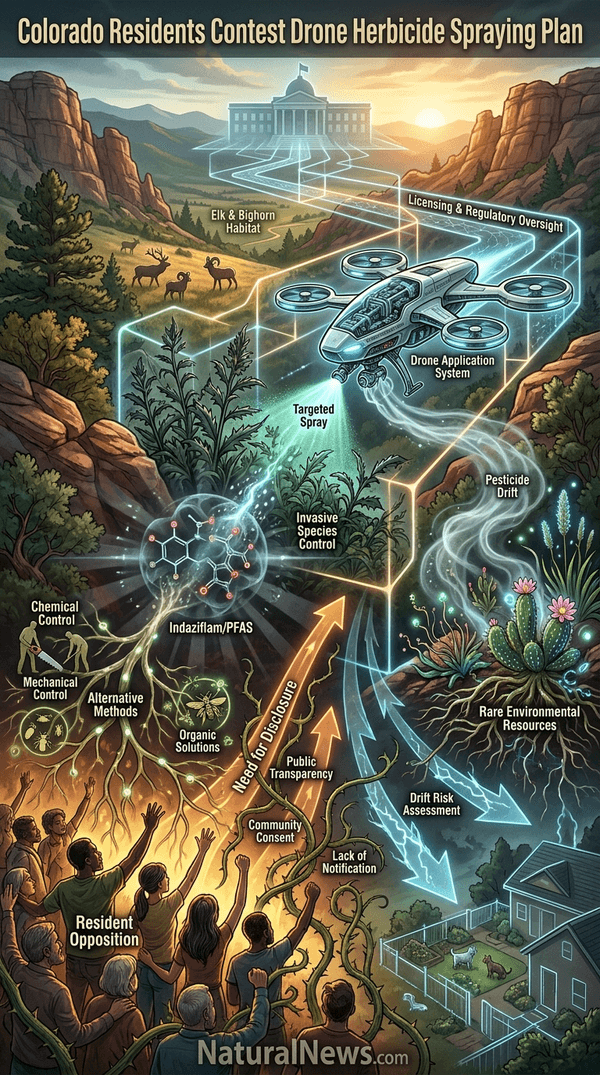
Explainer Infographic
Submit a correction >>
Tagged Under:
Bayer, big government, chemicals, Colorado, Dangerous, drones, Ecology, environment, freedom, herbicide, indaziflam, insanity, Liberty, outrage, pesticide, PFAS, poison, protest, Red Hill, Resist, toxins, weed killer
This article may contain statements that reflect the opinion of the author
RECENT NEWS & ARTICLES